26 April 2024

NVIDIA CEO Jensen Huang on Success

Check out this video clip of a Keynote by NVIDIA CEO Jensen Huang where he says the following:

"I think one of my great advantages is I have very low expectations... People with very high expectations have very low resilience. And, unfortunately, resilience matters in success. I don't know how to teach it to you except for, I hope suffering happens to you... Greatness is not intelligence, as you know. Greatness comes from character and character is not formed out of smart people, it's formed out of people who have suffered."

It took me many years, a tremendous amount of hard work and lot of setbacks to understand that low expectations and learning to suffer well are two very necessary requirements to build positive character.

24 July 2020

New TurboMed Braces

Recently I got some new braces  that only provide assistance with my foot drop. The idea is that I need to use my own body for every aspect of walking except upward foot movement (also known as dorsiflexion) now. This is due to my paralysis which now exists only in my ankles and feet (but muscle atrophy does still exist throughout my lower body). So, I need to push my body to get stronger by relying on it for all aspects of walking with the exception of dorsiflexion. The type of braces I wear are known as an ankle-foot orthoses or AFOs and are more common than you would think. Most often, I see someone wearing one, though I have seen two other people wearing two. As you can see in the video, all the cases shown are people wearing only one. In my case I need to wear two because I'm not dealing with only foot drop, but the bilateral paralysis from the spinal cord injury. 

I have not dove into wearing these braces full-time like I did with my current braces when I got them. In fact, it will be quite a while before I am ready for this because it's going to take time to build the strength to be able to do so. When I wear these braces in public (and I've only done this a couple times so far) I am back to using two arm crutches again because my muscles from my hips on down are just not strong enough yet. The crutches help me with stability and also with moving faster with my stride. So, I only wear the braces around the house right now but I'm doing this most days now. The result is increased soreness in my calves, hamstrings, hips and glutes from the use of more muscles. But this is a good thing because it means I'm still moving forward (believe it or not, I am very, very grateful for this soreness). One thing that's still very tough is foot placement as I take steps. This due to the lack of dorsiflexion in my feet and also just the general weakness in my lower legs. I'm hopeful that the dorsiflexion will come in time as I continue to build strength in my lower legs because I already have plantar flexion (downward foot movement).

From the video above, you can see there's not much to these braces. And the structure that is there is not high strength carbon fiber like my current braces. It's actually fairly soft and allows your body to do almost 100% of the work. This is the intention of these braces whereas my current braces are meant to replace all function of my calves and ankles which is huge difference! My current braces allow me to ambulate by compensating for my lack of calf and ankle strength with other muscles such as the hamstrings and glutes. While this gives me a lot of mobility it also means that my stride is not very big and I'm not using all my muscles like I would prefer to do eventually. I really like my current braces because they made me so much more mobile immediately when I began using them. But I had been wondering for a while if I had gotten new braces sooner how much further I would be by now. But I don't spend much time thinking about that because my body is already quite tired every night moving forward with the new braces every day and I'm very grateful for the progress I am making.

My goal is to wear these new braces more and more to force my body to become stronger over time. It's not easy at all. In fact, it's quite difficult and requires a level of acceptance that I had no idea I was capable of when all of this began six years ago. It's basically like a different kind of work out every day now (just imagine for a minute that simple walking was a difficult workout for you and you might understand my situation a bit better). I started using these new braces back in May but had to get into the habit of wearing them every day and just around the house. Now that I'm more into this habit over the last couple months, I'm already seeing some strength gains. So, I just need to keep moving forward.

15 August 2019

The Power of Gratitude and Optimism for Overcoming Barriers

Over five years ago, I was nearly killed in a cycling accident and sustained some serious injuries including a spinal cord injury. When I awoke in the hospital a couple weeks later, I was shocked to learn what had happened to me. At first, I couldn't make sense of it all. My entire self-identity had been twisted and turned inside out. Because I was paralyzed below the knees, my only mobility was via wheel chair and I had not even learned to use it yet. Every moment of the day, my mind reeled from one extreme to another and I didn't hold it together very well. I felt helpless and not in control of my body or my own existence. I saw the concern and helplessness in the eyes of my wife and daughters and friends. I didn't know how to help myself and they didn't know how to help me other than to provide me all their love and support. I was almost entirely dependent upon the nurses, doctors, PTs, OTs and techs to care for me. I didn't know it at the time, but this was true vulnerability and it was terrifying.

Optimism

As I was introduced to my PTs and OTs at Craig Hospital, they put me to work. I never knew exhaustion like the exhaustion I was experiencing from the work they had me doing. But my main doctor told me something within the first couple days of arrival at Craig Hopsital that has stuck with me even to this day. First he acknowledged my injuries and told me that most of them will heal in time. Then he told me to look around the hospital and take notice of how my situation compares to others -- I was extremely fit, I had broken bones that would heal, I had a family and a support system and there was a really good chance that, with a lot of hard work, I might walk again one day. Essentially, what he was telling me was to count my blessings. As I got to know other patients, I realized what he was saying.

I was in the hospital with people who had zero chance of ever walking again. Some of them had zero chance of ever even using their arms to hug someone again. It really broke my heart, but it also strengthened my resolve and opened my eyes in many ways. From that day on, I looked at my journey through life from a point of optimism.

There is a famous quote from the past about optimism that states:
A pessimist sees the difficulty in every opportunity; an optimist sees the opportunity in every difficulty
I was lucky enough to be able to adopt and embody this type of thinking early on in my healing and it continues to propel me to this day. But there was a turning point where this optimism really kicked in for me.

Discovery of Movement

Early into my recovery, my friend and neighbor suggested that I visit a muscle activation therapist (MAT) who had helped her in recovering from various running injuries over the years. For those who are not familiar with MAT, it defines a non-invasive, systematic process for assessing and correcting muscular imbalances, joint instability and limited range of motion. MAT is very powerful because it jumpstarts muscles to get them functioning and operating at maximum efficiency. The process really boils down to some very specific sort of muscle manipulation/deep muscle massage that can be very painful but highly effective. Anyway, I went to see this woman who is certified in MAT and I'm glad I did.

I was still in the wheel chair at this point, so I had to make it into the building and into her office. Then I transitioned to her massage table so that she could assess my paralysis through this deep tissue muscle manipulation of my lower body. I was surprised at the amount of pain I experienced from the manipulation. My muscles had not worked properly in many months due to the paralysis and she was basically awakening them and the nerves that control them. As she worked through different muscles she told me that nearly all the muscles that she manipulated were actually working but they were just diminished due to the atrophy and the lack of use over time. At this moment, something clicked inside me and I broke into tears of joy! I was so overcome because I had experience with recovering from muscle atrophy. She comforted me and was very pleasantly surprised herself at the assessment. Although the optimism was triggered by what my doctor said to me, this message about my condition is where I began to feel like I was in control again. I could decide how hard to work out to get these muscles moving again.

Due to my previous experience with recovery from three major knee injuries, I knew the hard work necessary for such recovery. What I did not know was that this recovery was not a journey of months, but many years. Here I am more than five years later and I am still working hard every day to build muscles and encourage more movement in areas of my body that are still healing. Little did I know that the energy of optimism would lend itself to further gratitude as time went on.

Gratitude

Beyond just being optimistic, I have also been lucky enough to be thankful for many things from early on with my injuries. As I described above, my doctor opened my eyes to some of the upsides of my situation. At that point, I had already been meditating for years to calm my mind. So, I began to meditate frequently on gratitude which quickly became my go to meditation. I spend this time focusing on things in my life for which I am grateful, and this has really helped me to continue and improve my mindset to this day.

One of the worst things that someone with serious injuries can experience is a mindset of pessimism. I have learned through experience that mindset can work as a self-fulfilling prophecy. That is, the mindset you choose to adopt can cause a cascading result throughout both your mind and body. This is not to say that a positive mindset will necessarily save you from a life-threatening illness or cure my paralysis. However, holding a negative mindset can certainly be a big barrier that prevents positive progress from being made. The strength of the mind over the body can be surprisingly powerful.

As I have mentioned before, the mantra of fake it 'til you make it has served me very well over time. Here's the bit of text from that link:
My wife Janene has always taught our girls that no matter what you're doing in life, you need to 'fake it 'til you make it'. This catchphrase helps you to feel confident and optimistic about something as you build your ability until such a time where you gain the necessary experience to actually feel genuinely assured that you have reached a successful point. Although she has always intended this for the benefit of our daughters, I have been able to internalize it and use it to my own benefit in my recovery. Repeating this statement in my head has taken me quite far and I continue to use it to this day.
Using this advice along with optimism and gratitude has helped get me to where I am today and the science around this concept actually proves it (don't believe me? Read Fake It Till You Make It: The Science Behind Smiling). Your body cannot tell the difference between fake confidence and real confidence. The same neural pathways fire, the same chemicals are released (dopamine, seratonin and testosterone). You can literally fake it until your brain makes it real.

I am lucky enough that my body continues to heal in various ways and that my family and friends continue to love and support me. Without these things in my life, I would not have made the progress I've made.

12 August 2019

My First Two-Wheel Ride Since My Spinal Cord Injury Five Years Ago


Yesterday, Janene took me for my first ride on a two-wheel bicycle since my injuries in 2014. I wasn't sure if I would ever be able to ride a two-wheel bicycle that I had enjoyed so much before the accident. It has been over five years since I've been on my mountain bike and the ride was glorious!

Some people have said to me, 'But you have been out riding since then, how were you riding if this is your first two-wheel ride?' This is true, I have been out riding in the last five years, but not on a two wheel bicycle. I actually have a three-wheel bicycle. Let me explain.

My Three-Wheel Bicycle

For some people with a spinal cord injury (SCI), depending on the severity of the damage, it can completely compromise your sense of balance. Sometimes this is a permanent change and sometimes it is temporary. You just don't know until you wait long enough for the shock to calm down in your body (for me, this took about six months) and the healing has begun. Anyway, because we were not sure if my sense of balance was going to be compromised or not and, because Janene was well aware of my passion for cycling, she wanted to get me back on a bicycle as soon as possible back then.

So, sometime within the first year after my injuries, Janene got me the most amazing three-wheel bicycle I have ever seen. It is a Mission Cycles Tribrid shown in the image to the right. This bicycle has disc brakes and gears similar to a two-wheel bicycle and although it's heavier than a two-wheel bicycle, it's actually pretty light compared to other three-wheel bicycles I've seen in the past. (In a previous life, I probably would have conspired to jump this three-wheel bicycle off a ramp or something!) However, the first big challenge that I had to overcome with even the three-wheel bicycle was finding a seat that I could sit on for any duration of time.

My Bicycle Seat Saga

Because my SCI occurred mainly in the lower lumbar spine, it also affected the sacral spine and therefore the nerves in that area. The sacral spine controls much of the movement and sensation below your waist. One of the issues I encountered was the nerves that control all my gluteal muscles and, to some degree, my perineum were all compromised. This meant that the muscles controlled by these nerves stopped working which caused tremendous muscle atrophy resulting in the muscles shrinking to almost nothing. So, the muscles in my butt and my crotch were compromised which made sitting on just about any surface very painful and difficult. Fortunately, these muscles just barely began working within five months of my injuries and have now recovered to some degree now. However, to this day, I still use special cushions to sit on and even with them I cannot sit still for very long. This made sitting in general very difficult for me, let alone on a bicycle seat. In fact, I need to wear two pairs of cycling shorts now for my stationary bike and my mountain bike. Even then, I can only make it for about an hour due to the pain. But, at least I can ride again!

Prepping For the Ride

Internally, I have been excited but nervous about getting back on my mountain bike. Long before my injuries back in 2010 or 2011, I had purchased this Yeti mountain bike (see the photo to the right). I have had several other mountain bikes, but this one has full suspension so it makes riding off-road trails sooooo much nicer. It's a superior uphill climbing machine. Anyway, I have been thinking about riding this bicycle for a long time. I even hopped on it once before but the seat caused me such pain that I had to get off quickly. So, I knew what I was up against with the limitations of my body and I had already been thinking about how I would overcome these long enough to get in a real ride duration. But getting my mountain bike ready for the ride was quite comical. It was as if all the forces in the universe were conspiring against me.

This bike still had the original seat and clipless pedals, so I knew that I had to change out those. But before I could start, I had to fix the flat tire on the rear which I discovered a couple weeks prior. So, I got a tube last week and swapped that out pretty quickly yesterday. Then I started working on the seat.

We had found a seat for the three-wheel bicycle that worked well enough for me to ride for about 30 minutes. So, I decided to grab the seat off the three-wheel bicycle and move it to my mountain bike. What I remembered as I was trying to mount the seat on the Yeti seat post was that the seat rails were a non-standard width and didn't exactly fit on the seatpost. Hmm, well I now remembered that I had to do the same thing on the three-wheel bicycle, so I just did the same thing on my mountain bike. With Janene's help, I got the seat mounted. Next, I moved on to the pedals.

In working to remove the clipless pedals on the mountain bike, I realized right away that I had to find my allen wrenches. After a hunt around the house, I found a different set but it didn't have an allen key big enough to remove my pedals. So, I called one neighbor and there was no answer. I called another neighbor and he said come on over and let's figure it out. He loaned me the correct size allen wrench. Then I had to actually break the seal to the pedals to remove them. This was no easy task, but we eventually conquered it. Now I needed to find one of my helmets.

This is where things get tricky. Since my accident five years ago, we have moved our master bedroom twice (once to the main level and once back upstairs). Additionally, last year we had to pack up everything on the first floor of our house and move out due to the remodeling. So, finding my cycling tools, helmets, cycling clothes, etc. required me to dig through many boxes to locate all the gear. I could not locate the helmet that I was searching for, so I still need to find that one. But anyway, two hours of prep work and we finally got ready and out the door for the actual ride!

The Actual Ride

Once we got rolling, I realized that I can still ride! Getting on and off the bike is not so easy for me and I had to lower the seat because I cannot move my ankles at all with the braces on my lower legs. But once I got moving, everything went great and we had a really good ride despite the pain.

One thing that I used to love about cycling was climbing hills. I could climb for hours and I loved it. But yesterday I quickly realized that even small hills were quite the challenge for me. Actually they are a very good challenge and I really want to do more of it. But I'm far from being ready to take on my favorite ride in Boulder County -- Flagstaff Mountain.

I was so thrilled to be able to feel the movement of being on a bicycle again. Now I can't wait to go on my next ride.

30 July 2019

Five Years Later...

Earlier this year in April, I reached five years since my spinal cord injury. Although this anniversary passed nearly unnoticed by many people around me, the value of what I have experienced in these five years still weighs heavy on me most days.

Back in April, I thought about writing this post, but I passed over it for some reason I can no longer recall. Most of the time I live my life in the new ways to which I have become accustomed and I'm able to deal rationally with most things that come up. But a couple weeks ago, I was driving to a hiking spot in Boulder County and I came across a cycling event. As I saw more and more riders it really threw me for a loop emotionally and I was so overcome I had to pull over. I see individual riders all over Boulder County all the time and I'm fine with that. I have accepted the fact that I cannot cycle the way I used to do so often. But I guess seeing all the people riding together for an event was a strong reminder of something I used to love and I still really miss. Anyway, this experience got me thinking and I figured I should write up something about the fifth year anniversary of my injuries because it's still very much always in the background (and sometimes the foreground) of my life.

Experiencing such traumatic injuries and going through the recovery was a profound experience for me physically, mentally and emotionally. As I just described above, there are still some life changes that get to me. There are big physical things like cycling events and even little physical things like the difficulty (or impossibility) of getting down on the floor to play with our puppies. Such physical limitations are something that I've learned to deal with the most. It's the mental and emotional stuff that still creeps up and surprises me from time-to-time.

Gratitude

As I have stated in a previous post, I still experience a tremendous amount of gratitude for the people in my life and for the experience that I've been through. Without going through something like this, it's difficult to understand what I mean. But recently I was reminded of it again by my fellow paraplegic friend John.

John and I meet up periodically since his own injury in 2017, but this time was a bit different. It was right before July 4th when he and I last hung out. John is doing amazingly well adjusting to life in a wheel chair. At one point, John paused to look me in the eye in a way that he never has. He then thanked me for something that I offered him early in his experience that he said he still holds to this day and it gets him through many daily difficulties. What I offered him was a statement that I learned from my wife Janene and that is, 'fake it 'til you make it.' He said that he didn't understand the value of this statement at the time, but since then he has grabbed ahold of it as a sort of mantra to move forward in his recovery and his life. I was quite touched that it has worked as well for him as it has for me.

In the last couple years, I have a newfound enjoyment in hiking. Although I cannot hike trails the way I used to (I used to run them!), I still get a lot of enjoyment out of the challenge of a trail and from being outside. I also find the solitude of hiking very comforting and I even seek out trails that are less busy for this reason. I used to say that cycling and running were both a form of meditation for me and now I've found that hiking can be the same for me.

But, overall, I think most about the positivity and support I continue to receive from family and friends. Without this, I would not be where I am today. I feel very fortunate to have so many people supporting me.

Improvements and Acceptance

So much of what drives me forward are the small gains that my body has made over the last five years. My nerve pain has improved dramatically over time, but it is by no means gone. The strength in my lower body has also improved dramatically over time, but by no means is my body at 100%. Such improvements and the positivity of the people around me are the hope that keeps me moving forward. But I have also had to face the fact that my body will never be the same.

Acknowledgement and acceptance are two related but very different concepts. Acknowledgement of my limitations is important, especially when it comes to gauging improvements on a day-to-day, week-to-week, month-to-month and even year-to-year basis. But acceptance of my limitations is a whole different level. While I have certainly accepted my injuries, what is not so easy to accept is some level of permanence of these injuries. This is a complex issue that has taken me quite a while to tease apart.

While I acknowledge the injuries to my body and I accept the fact that they happened, it is still difficult to accept the severity of these injuries as permanent. Consider a bone fracture. Relatively speaking, under optimal conditions, bone fractures do heal over time. However, healing a bone fracture oftentimes means immobilizing the joints around the bone fracture. The result of such immobilization is that the soft tissues around the fracture (e.g., ligaments, muscles, nerves, tendons, etc.) wind up experiencing damage due to the immobilization that lasts much longer beyond the healing of the original bone fracture. This soft tissue damage is a side effect to the actual injury, but it is the side effects that require prolonged physical therapy and hard work to overcome. It is these side effects that I am still dealing with today. Having spent two weeks lying in a bed in the ICU and then nine months in a wheel chair really took its toll on my body.

When movement begins to appear with a muscle for me, it doesn't mean that I can suddenly shed my leg braces and run down the street. It means that you can just barely see a flicker of movement in a muscle and it takes all the effort that I can possibly muster toward that muscle. Once this very minor movement begins to appear, the real battle is against the muscle atrophy and this is very, very difficult to overcome. It feels like no progress is being made and really requires a lot of mental focus not to be outdone by my own pessimism. Because such recovery requires a tremendous amount of consistent and diligent work over a long period of time, many people give up pretty quickly. I know I certainly have times where I feel like giving up. But I also know that the reward of regaining movement will not be affected by what I do on any given day, but is mainly affected by my long-term, consistent habits over time. In other words, it's about the long-term trend of the improvement. So, I keep telling myself that this is a marathon, not a sprint. I do my best to keep faith in the choices I make regarding my physical therapy, knowing that it's only going to make a difference over time. Much easier said than done.

Change is Constant

Looking back over the last five years, our family has undergone many changes. Five years ago, Bailey was 11 years old and Jade was 16 years old. Bailey was in elementary school and Jade was in high school and Janene was still working for the Colorado State Public Defender. Today, Bailey is in high school, has her drivers license and is beginning to consider university while Jade is about to enter her last semester of university to complete her student teaching and will then graduate. Janene has since retired from her position with the State and has opened her own private law practice. This a lot of change, albeit these are normal changes.

For me, life has changed quite a bit in the last five years. For the first nine months, I was in a wheel chair. This alone was quite jarring to me and everyone around me for a variety of reasons. One of the most difficult parts was not being at eye level with people and therefore always feeling vulnerable and somehow 'less than' what I once was. I still remember the first time that I walked in the hospital using a walker and with the help of two physical therapists. I couldn't believe how different the perspective was from my wheel chair vs. standing upright to shake someone's hand and look them in the eye. I remember thinking, 'I want this back!' This moment was a big motivator for me to learn to walk again using arm crutches, although it took an immense amount of hard work over those nine months. Since that time, I have spent the last four-and-a-half years focused on getting stronger and gaining better balance and more movement. It has meant doing some form of PT nearly every single day, so it has really become a way of life for me. I am very lucky to have gained much more strength throughout my lower body and even regained some movement. But the journey is far from over. I'm still hopeful that I will gain more movement in time so I just need to keep going.

It is also fascinating to look back at the videos that Janene took while I was learning to walk again. When I began trying to walk while I was still in the wheel chair, I was barely able to stand on my own with the arm crutches. As I tried to walk, I was literally throwing my legs forward to take steps. Over time, I progressed bit by bit toward actual walking with a more normal gait and somewhat normal strength. For me, it is shocking to see how weak my body was through this initial time period. It's always a reminder of how far I have come.

Onward to the next five years!

18 June 2019

My Principles for Hiring Software Engineers

Hiring is difficult. Hiring reliable, talented software engineers is even more difficult. In fact, hiring is probably the most arduous task that managers must handle, no matter what type of business you are conducting. And, based on the topic of Marc Andreessen's famous article Why Software is Eating the World, every conceivable industry is now being dominated by companies that are adept at developing software. So, the competition for good software engineers is pretty steep right now and will probably remain this way for the foreseeable future.

TL;DR (too long didn't read):
  1. The candidate must have a demonstrated hunger to continually learn 
  2. The candidate must be a culture fit
  3. The candidate must demonstrate humility

On with the background...

Throughout my years of hiring experience that began 20+ years ago, I have learned a thing or two. I've read many articles and books about hiring in the software industry and heard many opinions on the topic. The result of my years of experience is a set of principles that I follow when hiring. But before I get to these principles, let me explain what lead me to them.

Because I'm hiring from a management standpoint, I pay attention to aspects beyond just the candidate with the best technical skills and/or qualifications. I focus on team building which encompasses a myriad of aspects far beyond just technical aptitude. For me, team building requires the consideration of many different cross-cutting aspects beyond technical abilities. Below are just a few of the skills that candidates must possess:
  • Exhibit the skills necessary for software development
  • Demonstrate the ability to constantly learn and do it proficiently
  • Want to work as a team and collaborate closely with teammates
  • Communicate well
  • Behave like a professional 
  • Manage their own work schedule
  • Fit the culture 
  • Demonstrate empathy and humility
  • Not be an asshole
  • Etc.
Many of these skills can be taught and even bad habits can be broken with the right coaching, but the candidate must come through the door with some base skills intact. Let me walk through what I mean here. 

Consider trying to teach someone a complex task. First, if the complex task requires a large amount of prerequisite knowledge (like software development), then the candidate must demonstrate a certain level of technical aptitude. Let's assume they can successfully demonstrate their technical chops. Second, trying to teach someone is pointless if they are not interested in having others help them to learn or assume that they can figure it out themselves. In other words, sitting in the corner and coding away with zero communication with others is not allowed. Not only must the candidate be open to coaching and learning from others, they need to know how to learn and they must be proficient at learning. If the candidate possesses some of these base skills with the ability to learn and the willingness to be taught, then they can be brought up to speed over time. So, what I'm really looking for are some indicators of these characteristics in the candidates. These indicators are the principles that I have identified.

When I was asked some years ago to summarize these principles, I referred to them as culture-building. When building a culture, leaders must focus on the behaviors, expectations, norms and values that are most important for the environment and the work being done. Upon much consideration and over a long period of time, I was able to distill my hiring to the following three principles:

  1. The candidate must have a demonstrated ability and hunger to continually learn 
  2. The candidate must be a culture fit for the company, the environment and the people
  3. The candidate must demonstrate humility and empathy
In my experience, these three principles serve as indicators for someone who might be a fit for our culture and the position. Neither are these principles generic nor are they fool proof. You must adjust for different hiring needs. Also, we have had a couple duds over the years, but our turnover rate is less than 10% which is extremely good. Such a low turnover rate is partially due to hiring well and partially due to the benefits, compensation and perks from working for a large, global company that takes deliberate steps to care for its employees. Without these benefits, all the good hiring practices in the world won't stop your turnover rate from increasing over time. I also believe that you should pay people enough that they won't go elsewhere only for more money.

These three principles serve as a litmus test for a broad set of aspects as I noted further above. Here is some explanation around each of these principles:

  • The candidate must have a demonstrated ability and hunger to continually learn - I have met some engineers through my career who chose to go very deep with a very narrow skill set and no interest in spending time on things outside this narrow track. Without the interest to learn new topics and, the desire to do so all the time on an on-going basis, I have watched these people never move their skill set, never stretch themselves. For some positions, this approach is necessary. But for many/most positions, given the changing landscape in technology, I have found that the best candidates are always willing to make themselves uncomfortable to learn new things. Given the willingness to learn, a candidate must also be proficient at learning. If they find themselves pining away and making little progress, then they need consult someone they trust who can help them identify and conquer the hurdles they are facing. If you're willing to do this, it demonstrates a deeper sense of self which lends itself to things like helping others, being part of the collective, etc.

  • The candidate must be a culture fit for the environment and the people - Culture fit can mean a many different things. But, as I mentioned above, for me this term embodies the behaviors, expectations, norms, thinking, values (what is acceptable/unacceptable), working time, work ethic, etc. During interviews with a candidate, I have found it to be invaluable to include folks from the team where the open position exists. Everyone should be coached to take note of both verbal and non-verbal cues from candidates as there are many signals to be picked out that inform you of their true nature. Then, assessing these signals after the interview with the entire panel of interviewers oftentimes winds up telling a much different story than any one interviewer can tell about a candidate. Also, the questions you ask candidates can help to reveal many things, so be conscious of what you're asking and why you're asking it.

  • The candidate must demonstrate humility and empathy - This one is a bit odd for some people because it delves deeper into the psychology of a candidate, but it has proven to be very important measure over time. Anyone who has worked with people who have big egos will be able to recognize this -- the rock star developer who ignores input from others, the developer who sits in the corner coding away with zero communication, the developer who has high standards for themselves but does not want to take the time coach younger or newer team members, etc. When hiring members of a team, you are doing team building and this needs to be taken seriously. Teams of developers should operate like a team, not like a ship full of pirates who can't come together to deliver. This requires the ability to empathize with teammates, to assist one another, to exhibit a compassion for others, to be respectful, to be kind and to be humble. Without these characteristics, there may be serious disagreements on a team, even if those disagreements are not vocalized. Without an eye toward how one affects their teammates and how their teammates affect them, as a manager, you are just missing the boat. 

While these principles have worked for me, they may not work for others for various reasons. In the past, I have read that people don't leave a company, they leave a manager. While this can certainly be true (I've had my fair share of bad managers), I have left numerous companies not because of my manager, but because of the culture or the processes within the company or the lack of career growth opportunities. The three principles that I have outlined above assume that your company culture is healthy, useful and not problematic. If they are problematic, then as a manager you should be working toward improving them so that they are not problematic. When the culture and/or the processes are standing in the way of good hiring, all the principles in the world will not help you.

19 September 2018

Installing PostgreSQL 9.6 on macOS 10.13.6 via MacPorts for Development Purposes

After finally receiving a new MacBook Pro with 2.9 Ghz, 6-core i9 processor and 32gb of memory, I am reinstalling all of my development tools. Not only is the big increase in resources really useful from the development point of view, but the computer is lighter and thinner as well. That being said, there are still things I do not like, such as the keyboard, the touchbar (I miss the tactile feedback from the escape key which, as a Vim user, I use constantly) and some other minor things. For my own purposes, I usually document the steps to make it easier in the future. But I also figured it might help other folks out there to achieve the same ends.


Having documented this procedure once or twice before, I'm going to keep this brief.


BTW, below are the start/stop scripts that I created for PostgreSQL:


06 September 2018

GopherCon Denver 2018

Recently I attended GopherCon 2018 in Denver and really enjoyed the whole event. There were about 1500 people there and I really learned a lot. One of my teams writes Kubernetes operators using Golang which got me into writing some Golang myself.

On the first day, we attended a workshop titled Advanced Ultimate Go that was taught by Bill Kennedy from Ardan Labs and it was excellent. Not only is Bill incredibly knowledgeable with Golang (he has years of experience not only in Golang but also in C++) but he is also an extremely good teacher. I learned a lot in a single day and I would have loved to have this class extend for another day or even two.

Coming from a background of mainly Java for 20+ years, the Java community has an amazing piece of engineering in the JVM that handles most performance related concerns for us. We design Java classes however we please and we make use of any data structures we please and never really give it a second thought simply because the JVM handles all the real mechanics for us. With Golang, this is not the case. Although Golang has garbage collection (which is really nice, I hated using malloc() and free() in C) it's very different than what JVM does. Also, in many ways, the Go language is very succinct compared to Java. Both in terms of the amount of code you must write (Golang requires a lot less boilerplate code) to the ease of deployment with Golang (you have a single binary to deploy, no dependencies or CLASSPATH to manage). That being said, I'm still not sure that I would completely switch all web development away from Java to Golang. While the Golang learning curve is a lot easier than Scala, the issue I see are the implications on performance with the code you write. Whereas with Java, while there are performance concerns, as I said above the JVM handles a tremendous amount of things under the covers so that we don't have to care nearly as much.

Having spoken at many, many conferences over the years, I was very pleasantly surprised by the number of female attendees and speakers! I saw more talks delivered by women than I saw delivered by men which was excellent! The community seemed very open and engaging to everyone which I really liked. Being in the software industry for so long, it's still shocking to me how much of it is dominated by males. Anyway, I really enjoyed the cultural and gender diversity at Golang.

There is one minor change that I would like to suggest to the organizers of the Golang conference. Many years ago, I spoke at a conference in Denmark where I first saw this. On tables next to the doors at the back of a room where talks are taking place, there are big glass bowls with three piles of Post-It size paper, each pile a different color -- red, yellow and green. As attendees exit the room, they are asked to grab a single piece of paper in the color that represents how you felt about the presentation/talk. When the talk completes and the room is empty, the conference organizers gather the papers from the bowl, tally them up and provide the stats to the speaker. It's basically like a quick rating of what attendees thought of the talk. This small system does not replace the comment cards that organizers always ask of attendees because this is how attendees elaborate on they rated the talk the way they did. Both systems of rating are important because they deliver two different but equally important types of data to the organizers and the speakers. Anyway, this my two cents.

I really enjoyed GopherCon for a variety of reasons and I would love to attend again. Since the conference I have written a lot more Golang code and the more I write the more I like it. In my mind, Golang should be the goto language for systems programming, DevOps type stuff. While it can easily handle general web development tasks, I'm not sure yet if I would drop Java in favor of Go. I guess I need to keep coding away in both.

29 July 2018

Vacation and Hiking in Crested Butte

Last week my family and I took a week's vacation in Crested Butte to do some hiking and relaxing in the beautiful Colorado Rocky Mountains. Although we missed the Crested Butte Wildflower Festival by one week, we still enjoyed the flowers on our hikes.

As we explored the Crested Butte area and enjoyed numerous hikes, we got to spend time together as a family which I really enjoy doing. It's hard to believe that my girls are basically adults now (they are 15 and 20 years old). Bailey even got a second week of altitude camp in for her cross country training by running every day that we were there.

My in-laws even joined us with our two nephews and we all had a very relaxing time together. We even rented some paddle boards and went to Lake Irwin one day. This wasn't something that would have been very easy for me to do, so I enjoyed watching everyone experience the paddle boards for the first time in a cold mountain lake.

Crested Butte is a sleepy little mountain town with a well-known ski resort. We enjoyed hanging out in town, checking out the restaurants and shops, and also finding trails to explore all around the area, including on the ski mountain. Unfortunately, the Crested Butte ski resort was recently acquired by Vail Resorts. This means that it will be completely over-developed soon enough, everything will become too pricy and too crowded with traffic just like all the other resorts it owns. What a drag.

Later in the week, we visited a friend in Lake City and hiked Spring Creek Pass, a high mountain pass with an average grade of 7.5% at 10,901 feet. My phone told me that I climbed 50 flights of stairs that day which was quite an achievement for my withered legs. When we returned to the car, we took a photo by the trailhead sign and Janene had her arm around me and said, 'Your legs are shaking, you need to sit down.' I just chuckled and said, 'Yeah, I know.' Even so, I loved it! I am so thankful to be able to feel that exhaustion from completing a difficult hike.

12 April 2018

Forming Scrum Teams


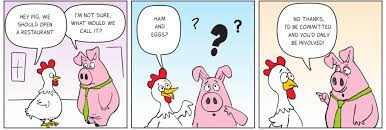
The tongue-in-cheek fable of the chicken and the pig is frequently referenced in Scrum literature to distinguish between people who are committed to the Scrum (the pigs) and people who are only involved (chickens). The reason pigs are committed is they must be sacrificed for the meal whereas chickens are simply involved. When I was software engineer, we used to say, 'It's just us pigs here' when it was a group of software engineers together. Having transitioned to management several years ago, now I say, 'It's just us chickens here.' But I digress.

In this post, I want to discuss my logic for forming Scrum teams, a topic that I have hashed and re-hashed many times throughout my career. So, here I will explain the logic behind how I form software engineering teams.

The Agile Manifesto

The Agile Manifesto lists the following 12 principles:

  1. The highest priority is to satisfy the customer via early and continuous delivery of software
  2. Welcome changing requirements
  3. Deliver working software frequently with a preference to the shorter timescale
  4. Business people and developers must work together daily throughout the project
  5. Build projects around motivated individuals
  6. The most efficient and effective method of conveying information to and within a development team is face-to-face conversation
  7. Working software is the primary measure of progress
  8. Agile processes promote sustainable development
  9. Continuous attention to technical excellence and good design enhances agility
  10. Simplicity is essential
  11. The best architectures, requirements, and designs emerge from self-organizing teams
  12. At regular intervals, the team reflects on how to become more effective, then tunes and adjusts its behavior accordingly

While these 12 principles define much of Agile in the broadest sense, there are variations in different Agile methods such as XP, Scrum, Lean, Kanban, etc. These methods are not meant to be followed dogmatically, instead practices within a particular method are meant to be guidelines. In this post, I will be focused on Scrum, specifically on some of the aspects of team formation. But keep these principles in mind as you read this post.

What Does Scrum Recommend?

The Scrum literature discusses team formation a lot. From this literature, it's easy to learn that there are  some key principles in Scrum focused around forming small, cross-functional teams. But Scrum best practices don't end there. There are many other aspects to building Scrum teams. In this post, I will elaborate on the following:

  • Autonomous and self-organizing
  • Team composition must be cross-functional
  • Ideal team size

Autonomous and Self-Organizing

As stated in many Scrum publications including the Scrum Guide, a Scrum team should consist of a Scrum Master (SM), a Product Owner (PO) and Developers. Scrum teams should be cross-functional and self-organizing, i.e., they must be capable of delivering value each sprint and they are responsible for deciding how they work. This is what I refer to as setting up a team for success. It's the job of the leader to set up the team for success, not only in the structure of the team but also in communicating the expectations for the team. I have always defined expectations in black and white for everyone to see so there is no question about their responsibilities. (In fact, I have even implemented this model across all engineering teams for a product line by working very closely with my management colleagues. There must be consistency of expectations across all the product engineering teams. I cannot stress this enough.)

It is critical that the team members understand and embody their autonomy and empowerment to manage their own work. Typically an engineering manager is involved and accountable, but the team is responsible (from a RACI matrix point of view). In my opinion, the best case scenario is that the engineering manager is more of a coach and not micro-managing everything a team does. Team members must be coached to step up whenever they can and remember to bring everyone along on the journey. This requires well-structured and open communication across the team. Oftentimes, the Scrum Master is the person who guides the team most in terms of self-organization and responsibilities.  It is also important that team members understand the role that everyone plays on the team. Like a set of gears moving together as one, it only works if all cogs are operating correctly and together.

Self-organization is an important aspect for a team to operate well together. Team members cannot operate together without a shared understanding of what this means. In Scrum, this means the PO defines user stores for team and the SM leads the team members in breaking down those user stories into subsequent tasks for estimation and execution. The SM oversees all of this activity and works closely with the PO to determine priorities for the sprint. While people not deeply experienced in Scrum think this is too much for a team to handle or feel that the manager should drive all team activities, this couldn't be further from the truth. As with many things in software, concrete experience teaches a tremendous amount very quickly. As a people leader, it's very easy to see the differences between a mature Scrum team and an immature Scrum team. Like many things in life, reaching a level of maturity as a Scrum team requires proficiency and time, especially if new team members are added over time. As the Agile Manifesto mentions: 
Build projects around motivated individuals. Give them the environment and support they need, and trust them to get the job done.

I work very hard to build trust with my engineering teams as I believe this is the basis for building great teams. I always say that I hire talented individuals who are experts and then I give them room to get the job done. The bottom line is the team is accountable for delivering value every sprint and I have found that building trust is a requirement. I extend trust to them to get the job done and they teach me to trust them by consistently delivering value every sprint.

Team Composition Must Be Cross-Functional

As mentioned above, a Scrum team needs to be cross-functional so as to deliver value every sprint. As much as delivering value is a generic term, when developing microservices it means that the team can deliver, own and operate those microservices itself. The team should not need to rely on other teams for different job functions as doing so amounts to dividing up teams based on function. This type of team organization was an idea from the 1990s and Waterfall methodology that divided up teams based on job function, e.g., front end engineers in one team, back end engineers in another team, QA in it's own team, tech writers in their own team, etc. I've seen this before and it really falls apart quickly because departmental divisions do not work in an Agile environment. It's a mismatch of models. Agile is supposed to be iterative and incremental. When teams are defined by job function they are not set up to be incremental. A true Scrum team must be composed of the constituent parts to deliver the software owned by the team. This requires a cross-section of roles composed of all the necessary disciplines. As mentioned above, a Scrum team should consist of a Scrum Master (SM), a Product Owner (PO) and Developers:
  • Scrum Master
  • Product Owner
  • Front end engineers (developers)
  • Back end engineers (developers)
  • DevOps engineers (developers)
  • QA engineers (developers)
  • Tech writer (developers)
  • Manager
In the list above, I included a couple of roles that you don't normally see in a Scrum team -- a tech writer and a manager. I also break down the different types of engineers. So, let's discuss each one.


Tech writer: I include a tech writer in my teams whenever I can because I do not consider the product to be Done until everything is actually done including the coding, testing, documentation, performance considerations and operational requirements.

Manager: I include the manager because this person serves a vital role not only in terms of people reporting lines but also in terms of developing a contextual understanding of a team and its work. Speaking from experience, without a manager present, it becomes very easy for software engineering teams to get pulled in many directions. A manager can guard against not only this but also against members of a team reporting to numerous managers which can result in a lot of chaos. 

The other roles are simply a clarification on the types of developers. Furthermore, it illustrates the inclusion of the different types of developer disciplines -- tech writers, QA engineers, DevOps engineers, etc. None of these disciplines or roles should reside on other teams. When this happens, the team will not develop the right level of cohesion and trust necessary to become what Google identified as an effective team (this is a whole separate topic for another blog post).

Ideal Team Size

I have seen Scrum teams with three engineers and Scrum teams with 30 engineers. The goal should be to find an ideal size that works for the products being developed, but I do believe smaller teams are better. According to the experience of many Scrum practitioners, the ideal team size should be 6-8 engineers (give or take one or two) not to exceed 10. From my nearly 20 years of experience practicing Agile, the larger an engineering team grows, the more difficult it becomes to meet, to scope work, to keep track of work, etc. Basically, the larger the team the more complex and time consuming communication becomes. It's not called Agile for no reason -- software engineering teams practicing Scrum are meant to be nimble and iterate quickly. This cannot take place when too many people are involved. 

Consider Brooks' Law about software project management which says adding manpower to a software project that is behind schedule will delay it even longer. This maxim emerged from Fred Brooks eponymous book The Mythical Man-Month. Brooks explains that while cost varies with the number of men and months, progress does not:

“Hence the man-month as a unit for measuring the size of a job is a dangerous and deceptive myth. It implies that men and months are interchangeable. Men and months are interchangeable commodities only when a task can be partitioned among many workers with no communication among them… This is true of reaping wheat or picking cotton; it is not even approximately true of systems programming.”

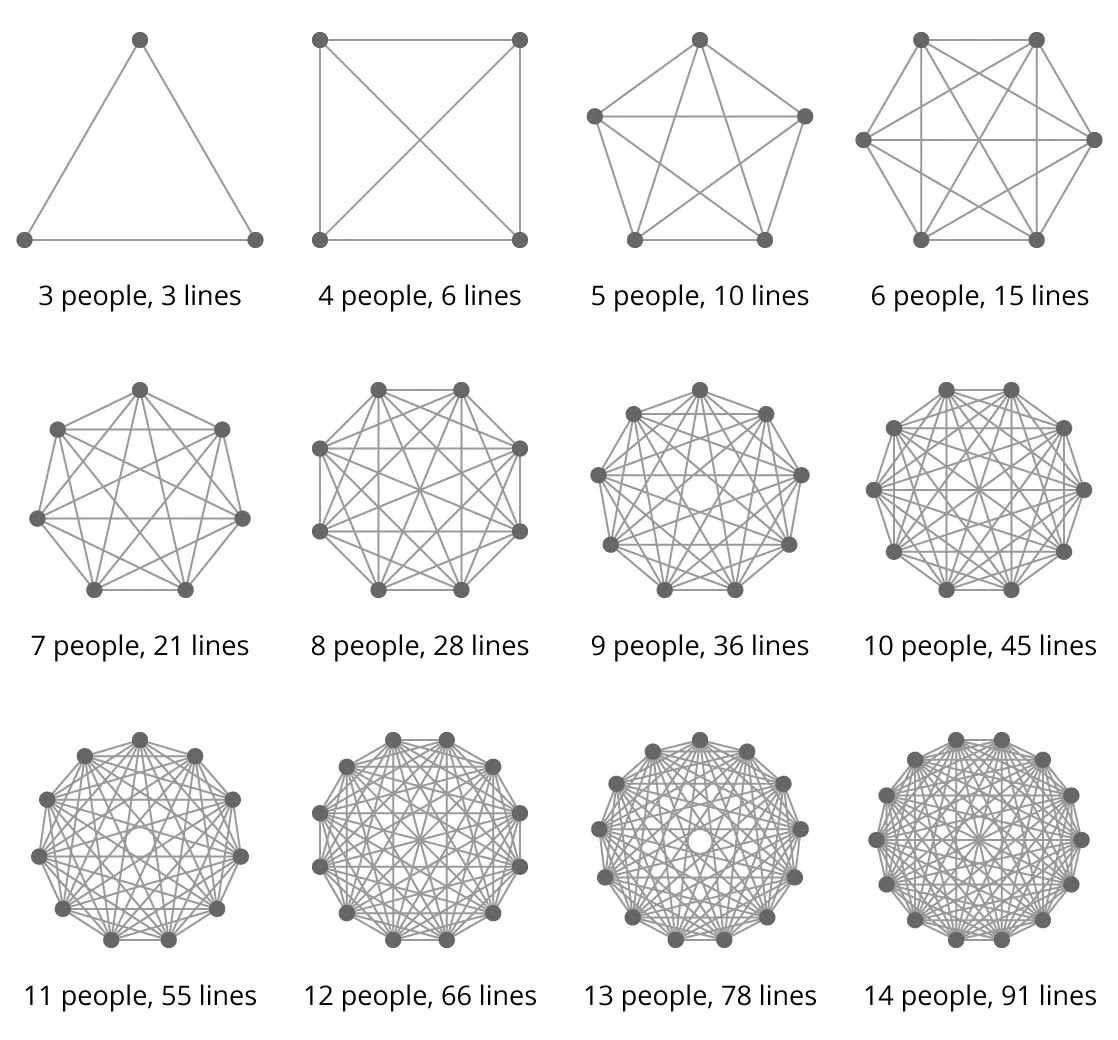
This is further elaborated by examining the lines of communication for teams of different sizes. As explained in a blog post titled, Lines of Communication and Team Size: Applying Brooks’ Law

Most teams in large enterprises have between 10 and 20 members. Even at the low end of that scale, a team has so many lines of communication that progress is bound to be slow.

(source: Lighthouse)

Note the increasing number of lines of communication as a team grows. This is essentially the root cause of why teams beyond the Scrum recommended size become more and more ineffective as they grow. The drag in trying to develop a shared understanding of anything simply becomes more and more complex the larger a team grows. This is typically when people start to complain about there being too much administrative overhead. 

Conclusion

To summarize, if you want to set up your teams for success, then they must be autonomous, self-organizing, cross-functional and sized appropriately for the software being built. This is at least part of the recipe that has helped me to build what I mentioned above that Google calls effective teams. 

Resources

23 March 2018

More Muscle Movement Discovered Recently

Recently I paid a visit to my physical therapist. I only see every 2-3 months to check in and guide me on the physical therapy work that I do on my own. She always checks out my progress to see how my body is doing and this time she found something new -- the tibialis muscles in both my legs are moving now!

The anterior tibialis muscles are what allow you to flex your feet upwards (this is called dorsal flexion). So far, I have only been able to press my feet down (this is called plantar flexion) because this is controlled by the calf muscles. But now that the anterior tibialis muscles are moving ever so slightly, I can begin to rebuild these as well. Just like my calves are taking time, these muscles will also take time to rebuild as well.

I am still working to rebuild my calf muscles and this is slow. My physical therapist reminded me that I'm not just strengthening my calves. I literally had no calf muscles left. So I am rebuilding my calves from nothing which is much more difficult. She also said that at this point, we have no idea if the calves are fully firing or not. In situations where there is nerve damage, you never know if you are getting a full squeeze from the muscle or if the whole muscle is firing yet. This makes the work much, much more difficult. She also told me that this is why most people give up.

My calves are increasing in size and strength, but they are very far from 100% functionality or strength. I still have a long way to go. But I still feel lucky to be where I'm at today with my body still healing.

04 September 2017

New Braces and Hiking in Colorado

After about a year-and-a-half of wearing my old carbon fiber AFO braces (Ankle and Foot Orthoses), I recently got a new pair of Phat Braces which are also made of carbon fiber, but have a much better warranty and are widely used by people everywhere.  The big difference between my old braces and the new Phat Braces is that the Phat Braces are taller and stiffer (but they are beginning to soften a bit). They come up my leg to right below my knee which is further than my old braces . This makes them much more stable and it which allows me to balance and walk much easier. They also have some flexible plastic that wraps around the foot (as you can see in the image to the right) which also helps to provide more stability. The biggest benefit about them so far, however, is that it did not take my body six weeks to adjust to them. The previous braces actually took six weeks for my body to adjust and I was in pain the entire time. The company that provided them told me that's just how it goes. Through that adjustment period, I had to have at least a dozen manual adjustments to the carbon fiber (e.g., heat them up, bend out here and there, etc.), probably closer to 18 or so. With the new Phat Braces, I've only had two adjustments and my body has already adjusted to them -- literally less than a week. In fact, I have had the Phat Braces two weeks now and yesterday I did my first true Colorado hike since my injury in April 2014!


Yesterday we decided to go hiking in Evergreen, CO because we were trying to get back to the spot where I proposed to Janene 20 years ago. We thought it would be cool to go back there because later this month Janene and I will be celebrating our 20th wedding anniversary. I was a bit intimidated when we started the hike because of the elevation gain on the trail and the number of large rocks that you hike over on the trail. I did take a single arm crutch with me but it almost made things more difficult because of the angle at which you hold the arm crutch vs. the angle of the rocks on such an uphill elevation. Also, my new braces make going uphill difficult because they are still stiff, but they will soften a bit more in time. But with Janene's help, I completed the hike. Janene did make a good suggestion that instead of using an arm crutch I should consider getting some hiking poles. Because you hold them at a different angle, it could make going uphill and downhill over rocks easier for me. So, I'm going to try some out soon at REI.

Although the distance was not that great (1.7 miles), this was the most uphill/downhill I have done since my spinal cord injury 3.5 years ago -- I actually impressed myself. As proof of the level of workout for my body, my lower back and my hips were really tired after the hike and sore this morning. But I really enjoyed getting out for a hike with Janene and Bailey. So, I'm really looking forward to doing more hiking. I guess I can really start enjoying the fact that we live in Colorado again!

27 April 2017

Three Years After

Monday, April 24th marked the third anniversary of my spinal cord injury. It seems like the injury took place so long ago now and yet it has only been three years. So much has happened in my family's life in the last three years. I now have a 19-year-old who is about ready to complete her first year of college and a 14-year-old who is getting ready to enter high school in August. Through all of these experiences along this journey, I now feel like I am emerging from the other side. I believe that I have finally found peace with this whole ordeal. It has not been easy to get to this point and it's difficult to convey how hard-fought my successes continue to be. But those closest to me know, and that's what matters to me.

Gratitude

As I look back at all the photos and videos Janene has taken over this three year period, read through the Caring Bridge posts and my blog posts, the progress I have made is pretty amazing to me. Believe it or not, I actually have a lot of gratitude for the fact that this experience happened to me. Yes, I just said that I am thankful for the experience. I did not arrive at this place easily or lightly, so stop and consider that statement for a moment. After three years of pondering every aspect of this entire situation, I feel that I am a better person for it in many ways. This whole experience forced me to get myself in order and I'm now a better person for it.

From the beginning of this experience three years ago, I have been lucky enough to be surrounded by people who provided me a constant stream of positive support. From the folks I worked with at the hospitals to all of my family, friends and co-workers, the positive vibes are what have inspired me to keep going. There were also a couple of notable things that two people told me that I have hung on to that have kept me going to this day:
  • My wife Janene has always taught our girls that no matter what you're doing in life, you need to 'fake it 'til you make it'. This catchphrase helps you to feel confident and optimistic about something as you build your ability until such a time where you gain the necessary experience to actually feel genuinely assured that you have reached a successful point. Although she has always intended this for the benefit of our daughters, I have been able to internalize it and use it to my own benefit in my recovery. Repeating this statement in my head has taken me quite far and I continue to use it to this day.

    Although she has always intended this for the benefit of our daughters, I have been able to internalize it and use it to my own benefit in my recovery. Repeating this statement in my head has taken me quite far and I continue to use it to this day. Thank you so much, Janene. I love you!
  • My friend Greg, who has had two spinal cord injuries in his life (can you believe that?!), told me something very early on in my journey, that I held in my head to help me get through the first year and beyond. He said something like, 'I know you you are not in a place where you can understand what this means yet, but you will get there in time. Just do everything you can to make it through the first year and everything will seem 1000% better. You won't be totally healed in one year, but you will feel much, much better.' Ironically, I saw Greg the week of my first year anniversary and I told him about this and he didn't even remember telling me this. I think he was quite surprised that I held on to it for so long, but it was truly a lifeline. Thank you, Greg.

Lesson Learned

I have learned a lot in three years as this experience has taught me a lot, especially the way that you handle an experience. Most importantly, I've learned that when you are faced with a horribly painful experience (emotionally, mentally, physically) that changes your life, you can choose to one of two paths:
  1. Either, you can be angry, resistant, resentful and stuck on the fact that something was taken from you. I have met plenty of people on my journey who were here and until they change their outlook, they won't be able to move on.
  2. Or, you can acknowledge that it sucks but still feel gratitude for the positive aspects and for being able to be alive to experience it all. I haven't met any people who can say that they feel thankful for their experience with a spinal cord injury, but I have read about some. It was not easy for me to get to this point.
And this certainly doesn't mean that I'm done. My recovery will continue for years.

On that note, singer-songwriter Ryan Adams who I have listened to for years summarizes my whole point best in the following interview:
He says it best by summarizing it this way: Pain helps us learn who we really are.

Reminders Along the Journey

Just recently, one of my colleagues from our Munich, Germany headquarters visited my office in Boulder. I have not seen this guy in person since before the accident so he was really shocked to see me walking and to see how well I am doing now. He said he was so surprised because the last he heard from me I was still in the wheelchair (the look on his face was priceless!). It's moments like this one that remind me of how far I've come and continue to drive me forward.

Thank you to everyone who has helped me in any way along this journey.

09 March 2017

Annual Spinal Cord Injury Re-evaluation

Recently I went back to Craig Hospital for an annual spinal cord injury re-evaluation and the results were very positive. It was really nice to see some familiar faces of the people for whom I have such deep admiration like my doctors, physical therapists and administrative staff. My doctor and therapists were quite surprised to see how well I am doing, especially given that I'm still seeing improvements three years later. Mainly because so many spinal cord injury patients have serious issues even years later. I am so lucky to no longer be taking any medications and to be walking again.

It has also been nearly one year since I have been back to Craig Hospital and it seems like such a different place to me now. Being back there again feels odd for a couple of reasons. First, due to the extensive construction/remodel, the amount of change to the hospital makes it seem like a different place entirely. It used to be much smaller which encouraged more close interaction between patients and staff. Now the place is so big (i.e., big hallways, larger individual rooms, etc.) that patients can have more privacy if they want or even avoid some forms of interaction. Second, although I am comfortable being around so many folks who have been so severely injured (not everyone is), I have noticed that some folks are confused by me. I can tell the way they look at me that they are wondering what I am doing there because, outwardly, I do not appear as someone who has experienced a spinal cord injury. I have been lucky enough to make it out of the wheelchair and to walk on my own. Though my feet are still paralyzed, I wear flexible, carbon fiber AFO braces on my legs and walk with one arm crutch, the braces are covered by my pants so it's puzzling to many people.

The folks who I wish I could see more are the nurses and techs. These are the folks who helped me the most when I was so vulnerable and confused and to whom I grew very attached. To understand just how attached I was, simply moving to a more independent room as I was getting better was upsetting to me because I was so emotionally attached to them. I learned that these people are cut from a unique cloth and possess very big hearts to do the work they do every day. Because they are so involved with the acute care of in-patients, they are very busy during the day and not available for much socializing as past patients come through. Luckily, there was one of my nurses who I ran into and was able to spend some time speaking with him. I really enjoyed catching up with him and hearing about new adventures in his career. He was one of the folks I was attached to at the time and he really made a difference in my experience. I will be eternally thankful for having met these wonderful people during such a traumatic time in my life.

Today I am walking nearly 100% of the time with the leg braces and have been for over two years. I am working to rebuild my calves and my glutes, but this is a very, very long and slow process due to severe muscle atrophy after not being able to move my glutes for five months and my calves for two years. Although my feet are not responding yet, we will see what the future holds. I still feel so very lucky to be alive and continuing to make progress.

Although I cannot run at all or cycle the way I did previously, I am very thankful to be able to work out as much as I can. I am now riding the stationary bike regularly, using my Total Gym (yes, I have a Chuck Norris Total Gym) to build my calves, using a Bosu to work on balance and strength in my lower body, doing ab roller workouts and walking as much as I can both indoors on a treadmill and outside. I'd like to make time for swimming laps again, but all of this can be time consuming (and tiring!). I am not nearly as fit as I was at the time of my injury, but I continue to work hard and to see noticeable improvements for which I am truly thankful.

Thank you to everyone who continues to stay in touch and check in on me from time-to-time. You may not think it's much to send a quick message, but these messages have meant a lot to me through this process. The support from family and friends has been what has truly kept me going. The patience displayed by Bailey, Jade and Janene is pretty amazing.

Next month will mark the three year anniversary of my injury. It seems so far away and yet it continues to affect my life every day. My life will never be the same, but I do believe I have found peace with this entire ordeal.

20 March 2016

Martyn Ashton Is Soooooo Inspirational For Me! :: Bruce Snyder's Status


Imagine for just a moment, if you will, you are going through your day and everything is routine -- you take the kids to school, you collaborate with some co-workers, you eat some lunch and then you head outside for a bike ride. You are enjoying the weather, riding your bike and suddenly something goes terribly wrong. You don't understand, you hear someone screaming but you can't figure out what is happening. Then you realize... the screaming is you.

Blinding pain, you are bleeding, breathing is getting increasingly difficult, you are physically unable to move your legs, paramedics telling you things you don't understand, doctors and nurses running frantically and then blackness.

When you regain full consciousness in the hospital a couple of weeks later, you are confused and scared, still unable to fully comprehend the situation. Then reality sets in like a swift blow to the head as you become aware that the last two weeks were not a horrible, dark nightmare.

This is what I lived through from my cycling accident. Nearly two years later, I am now making it out the other side of my injuries and this video of Martyn Ashton back on his bike is the most inspirational thing that I have seen so far! Thank you, Martyn! I recommend watching it in full-screen mode with the volume turned up so you can hear the laughter of these friends as they help their buddy get back to the sport he loves.
'I am now making it out the other side of my injuries and this video of Martyn Ashton back on this bike is the most inspirational thing that I have seen so far!'
The joy on Martyn's face at getting to ride his bike again is amazing and seeing his friends set him up on his bike and careen down the mountainside together bowls me over every time I watch it. I dream of doing this again one day!

Martyn Ashton has been a professional mountain biker for over 20 years and in 2013 he experienced a spinal cord injury while on his bike. Martyn is now wheelchair bound, his life changed forever. To understand why this video has such a dramatic efffect on me, check how talented Martyn was on his bike before his accident in this wildly popular video of him (nearly 1.2 million hits!). This is truly inspirational for me and I wish Martyn continued success!

For an interview about the main video I posted above, check out this interview with Martyn.


28 February 2016

We Have Movement! :: Bruce Snyder's Status


After nearly two years of no movement below my knees, I was pretty surprised to discover recently that there is movement in the achilles tendons on both my legs!

Back in late January, I went back to Craig Hospital for the annual re-evaluation of my spinal cord injury. During the four days of poking and probing my body, just like last year, they told me again, 'According to your internal organs, we can't tell that you have had a spinal cord injury.' This does not mean that I am unaffected, it means that I do not have the deterioration of internal organ function that they commonly see in the kidneys, liver, etc., etc. after such an injury. Many paraplegics are in a very bad way internally due to a whole host of issues that arise as side effects to the nerve damage. For example, I still have to deal with bladder and bowel issues from the nerve damage. These issues have improved significantly from the time of the injury nearly two years ago, but I am also lucky enough that my injuries were not as bad as they could have been. (I could go on an on about the degrees of damage here but I will spare you the details.)

There were two really positive discoveries during my re-evaluation, improvement in sensation and some new movement. The first discovery that I have much more sensation in my hamstrings, lower legs and feet than I realized. Nerves heal at such a slow rate that it's difficult to gauge the level of improvement on any given day. But if you have a baseline against which you can measure, then you can quantify the amount of improvement. I knew that the sensation had improved, but it was difficult to tell how much it had improved. Additionally, if you know anything about nerve sensation then you know that there are different flavors of it -- basically soft/light touch to heavy touch to sharp touch (and everything in between). Interestingly, damaged nerve sensation can go from numb at one end of the spectrum to hypersensitive at the other end. So they tested much of my body for nerve sensation and compared my current results to the results from one year ago as well as against the initial injury. The result was that the improvements were rather significant.

If you look at the two images above of the nerve dermatomes, pay attention to those from the waist down related to anything L3/L4 or below (the vertebrae in the lower spine including L3, L4, L5, S1, S2, S3, S4 and S5). Right now I'm dealing with sensation issues in my feet, lower legs, hamstrings, tailbone and crotch areas. The great thing is that my body is still healing and nobody knows how far it will go over time.

The second discovery was that the achilles tendons in both legs have some movement! There was just barely movement there, but it's movement nonetheless. It is very similar to the way that my butt/glutes returned. This new movement in my achilles tendons was such a minor amount of movement that I did not believe it at first. However, as my glutes have recovered and rebuilt, I have also learned that even minor movement can snowball over time into much more movement as the muscles are rebuilt. My glutes have largely returned, but they are still not 100% and won't be for some time, so I continue to work on rebuilding them. The same will be true for my calves. Right now my calves are basically gone due to the muscle atrophy. But, over time, I will enlist my calf muscles more and more and they will rebuild. In fact, in the 30 days or so since the movement in my achilles tendons was discovered, I can now feel that my calves are just beginning to engage. But only just beginning. It's going to take a lot more work over a long period of time before I can visibly produce dorsi- or plantar-flexion of my feet (which is driven by the calf muscles and the tibialis muscles).

As I have been telling everyone for the last year, in addition to waiting for my nerves to heal more, the big focus of my physical therapy has been fighting back against the severe amount of muscle atrophy that occurred as a result of my injuries and immobilization. It took me a while to realize that the muscle atrophy was something from which I could recover (as long as there was movement). At first, I was so weak from the immobilization after the emergency surgery and spending nine months in a wheelchair that I just assumed that the weakness was caused by and part of the paralysis. To a certain degree this was true, but what I have learned over time is that if I have movement I can rebuild the muscle. There is such a thing as having the movement return but perhaps not having 100% of the sensation return. Another positive thing is that I have experience dealing with muscle atrophy. Having dealt with it way back in high school with my first couple of knee injuries, I understand the dedication and hard work required to recover from muscle atrophy. It takes a lot of consistent, deliberate, difficult work to rebuild muscles that have shrank away. As many people have asked me, 'Are you still going to PT?' and my response is, 'PT is a way of life for me, it won't stop for years.'


Anyway, because the movement is starting to return, I was fitted for a new kind of braces (this is the third type of braces now). The type of braces I need are called ankle-foot orthotics or AFOs. The first type of AFOs I had were rigid hybrids comprised of aluminum struts with plastic foot and calf beds. The second type of AFOs I had were rigid plastic with some carbon fiber reinforcement around the ankles -- rigid meaning no flexion whatsoever. I am now on the third type of AFOs and these are known as dynamic response AFOs and they are made of carbon fiber.

See the image to the right and notice that there is only a thin strip of carbon fiber along the back of the achilles tendon area. This strip is flexible for two reasons:
  1. To enlist the calf muscles in the stride
  2. To rebound or spring back once it is loaded from the ankle flexion providing a more natural stride 
Just like the switch to the previous AFOs, these new AFOs changed my stride again. It's much more natural and I don't need to pick up my feet as much because my ankles are flexing naturally. The downside is that I am pretty damn wobbly right now due to my lack of calf or foot muscles, but this will improve over time. Also, my feet and lower legs are pretty sore from the new material (carbon fiber is not very forgiving -- I know this from owning several carbon fiber bikes). I have already had a couple of adjustments to them and I will need more. But it is also a matter of your body getting used them, kinda like a new pair of shoes but much worse. This will all improve over time.

Someday I will post all of the videos that Janene has made of me walking at the different stages throughout my recovery. It's pretty amazing to see the progress so far and I'm not even done yet. As I tell myself quite often, never give up.