29 July 2018
Vacation and Hiking in Crested Butte
12 April 2018
Forming Scrum Teams
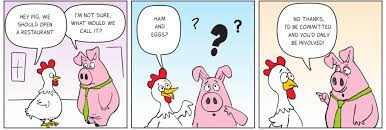
The tongue-in-cheek fable of the chicken and the pig is frequently referenced in Scrum literature to distinguish between people who are committed to the Scrum (the pigs) and people who are only involved (chickens). The reason pigs are committed is they must be sacrificed for the meal whereas chickens are simply involved. When I was software engineer, we used to say, 'It's just us pigs here' when it was a group of software engineers together. Having transitioned to management several years ago, now I say, 'It's just us chickens here.' But I digress.
The Agile Manifesto
- The highest priority is to satisfy the customer via early and continuous delivery of software
- Welcome changing requirements
- Deliver working software frequently with a preference to the shorter timescale
- Business people and developers must work together daily throughout the project
- Build projects around motivated individuals
- The most efficient and effective method of conveying information to and within a development team is face-to-face conversation
- Working software is the primary measure of progress
- Agile processes promote sustainable development
- Continuous attention to technical excellence and good design enhances agility
- Simplicity is essential
- The best architectures, requirements, and designs emerge from self-organizing teams
- At regular intervals, the team reflects on how to become more effective, then tunes and adjusts its behavior accordingly
While these 12 principles define much of Agile in the broadest sense, there are variations in different Agile methods such as XP, Scrum, Lean, Kanban, etc. These methods are not meant to be followed dogmatically, instead practices within a particular method are meant to be guidelines. In this post, I will be focused on Scrum, specifically on some of the aspects of team formation. But keep these principles in mind as you read this post.
What Does Scrum Recommend?
The Scrum literature discusses team formation a lot. From this literature, it's easy to learn that there are some key principles in Scrum focused around forming small, cross-functional teams. But Scrum best practices don't end there. There are many other aspects to building Scrum teams. In this post, I will elaborate on the following:
- Autonomous and self-organizing
- Team composition must be cross-functional
- Ideal team size
Autonomous and Self-Organizing
Build projects around motivated individuals. Give them the environment and support they need, and trust them to get the job done.
I work very hard to build trust with my engineering teams as I believe this is the basis for building great teams. I always say that I hire talented individuals who are experts and then I give them room to get the job done. The bottom line is the team is accountable for delivering value every sprint and I have found that building trust is a requirement. I extend trust to them to get the job done and they teach me to trust them by consistently delivering value every sprint.
Team Composition Must Be Cross-Functional
- Scrum Master
- Product Owner
- Front end engineers (developers)
- Back end engineers (developers)
- DevOps engineers (developers)
- QA engineers (developers)
- Tech writer (developers)
- Manager
Tech writer: I include a tech writer in my teams whenever I can because I do not consider the product to be Done until everything is actually done including the coding, testing, documentation, performance considerations and operational requirements.
Ideal Team Size
I have seen Scrum teams with three engineers and Scrum teams with 30 engineers. The goal should be to find an ideal size that works for the products being developed, but I do believe smaller teams are better. According to the experience of many Scrum practitioners, the ideal team size should be 6-8 engineers (give or take one or two) not to exceed 10. From my nearly 20 years of experience practicing Agile, the larger an engineering team grows, the more difficult it becomes to meet, to scope work, to keep track of work, etc. Basically, the larger the team the more complex and time consuming communication becomes. It's not called Agile for no reason -- software engineering teams practicing Scrum are meant to be nimble and iterate quickly. This cannot take place when too many people are involved.“Hence the man-month as a unit for measuring the size of a job is a dangerous and deceptive myth. It implies that men and months are interchangeable. Men and months are interchangeable commodities only when a task can be partitioned among many workers with no communication among them… This is true of reaping wheat or picking cotton; it is not even approximately true of systems programming.”
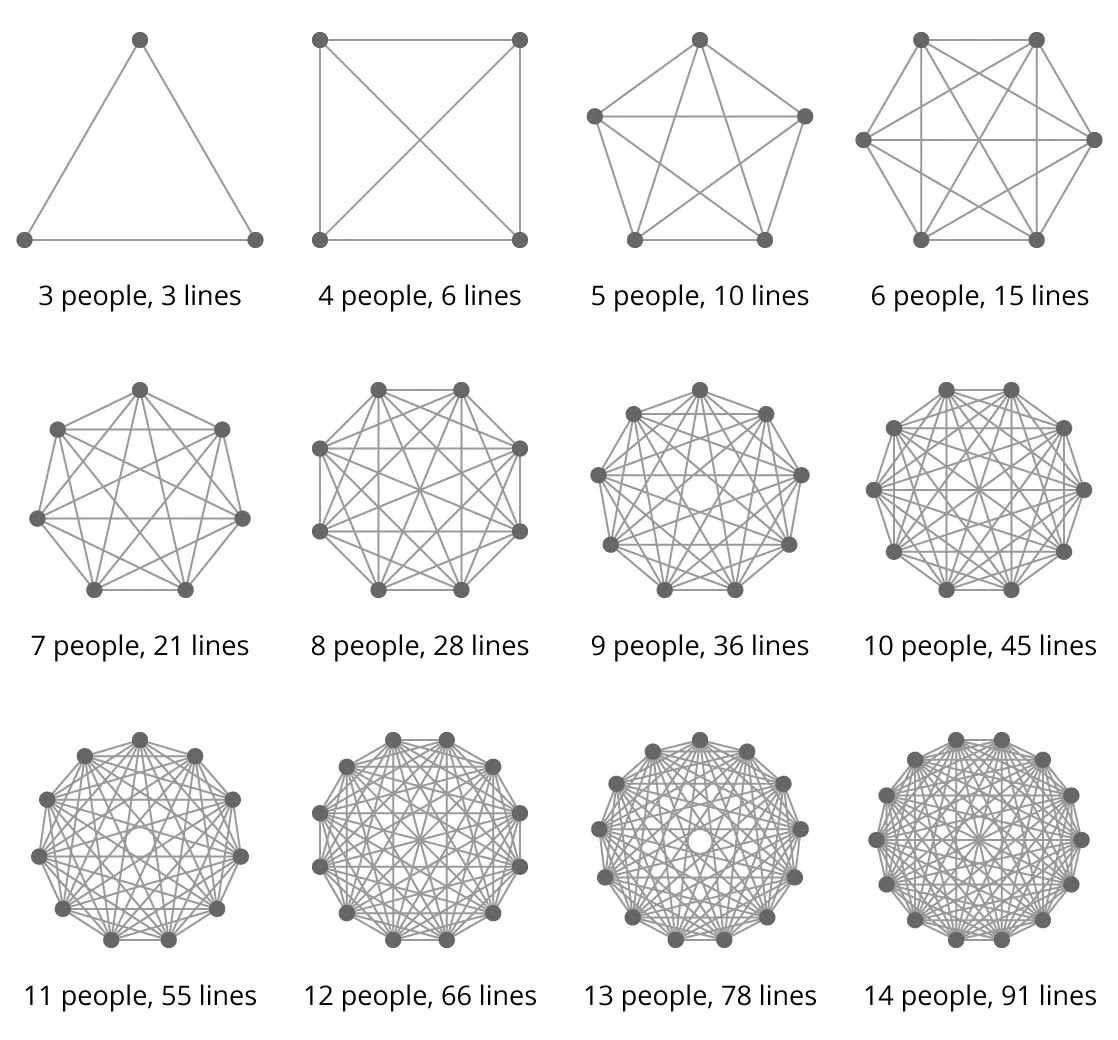
This is further elaborated by examining the lines of communication for teams of different sizes. As explained in a blog post titled, Lines of Communication and Team Size: Applying Brooks’ Law:
Most teams in large enterprises have between 10 and 20 members. Even at the low end of that scale, a team has so many lines of communication that progress is bound to be slow.
![]() |
| (source: Lighthouse) |
Note the increasing number of lines of communication as a team grows. This is essentially the root cause of why teams beyond the Scrum recommended size become more and more ineffective as they grow. The drag in trying to develop a shared understanding of anything simply becomes more and more complex the larger a team grows. This is typically when people start to complain about there being too much administrative overhead.
Conclusion
To summarize, if you want to set up your teams for success, then they must be autonomous, self-organizing, cross-functional and sized appropriately for the software being built. This is at least part of the recipe that has helped me to build what I mentioned above that Google calls effective teams.
Resources
23 March 2018
More Muscle Movement Discovered Recently
Recently I paid a visit to my physical therapist. I only see every 2-3 months to check in and guide me on the physical therapy work that I do on my own. She always checks out my progress to see how my body is doing and this time she found something new -- the tibialis muscles in both my legs are moving now!
The anterior tibialis muscles are what allow you to flex your feet upwards (this is called dorsal flexion). So far, I have only been able to press my feet down (this is called plantar flexion) because this is controlled by the calf muscles. But now that the anterior tibialis muscles are moving ever so slightly, I can begin to rebuild these as well. Just like my calves are taking time, these muscles will also take time to rebuild as well.
I am still working to rebuild my calf muscles and this is slow. My physical therapist reminded me that I'm not just strengthening my calves. I literally had no calf muscles left. So I am rebuilding my calves from nothing which is much more difficult. She also said that at this point, we have no idea if the calves are fully firing or not. In situations where there is nerve damage, you never know if you are getting a full squeeze from the muscle or if the whole muscle is firing yet. This makes the work much, much more difficult. She also told me that this is why most people give up.
My calves are increasing in size and strength, but they are very far from 100% functionality or strength. I still have a long way to go. But I still feel lucky to be where I'm at today with my body still healing.
04 September 2017
New Braces and Hiking in Colorado
After about a year-and-a-half of wearing my old carbon fiber AFO braces (Ankle and Foot Orthoses), I recently got a new pair of Phat Braces which are also made of carbon fiber, but have a much better warranty and are widely used by people everywhere. The big difference between my old braces and the new Phat Braces is that the Phat Braces are taller and stiffer (but they are beginning to soften a bit). They come up my leg to right below my knee which is further than my old braces . This makes them much more stable and it which allows me to balance and walk much easier. They also have some flexible plastic that wraps around the foot (as you can see in the image to the right) which also helps to provide more stability. The biggest benefit about them so far, however, is that it did not take my body six weeks to adjust to them. The previous braces actually took six weeks for my body to adjust and I was in pain the entire time. The company that provided them told me that's just how it goes. Through that adjustment period, I had to have at least a dozen manual adjustments to the carbon fiber (e.g., heat them up, bend out here and there, etc.), probably closer to 18 or so. With the new Phat Braces, I've only had two adjustments and my body has already adjusted to them -- literally less than a week. In fact, I have had the Phat Braces two weeks now and yesterday I did my first true Colorado hike since my injury in April 2014!
Yesterday we decided to go hiking in Evergreen, CO because we were trying to get back to the spot where I proposed to Janene 20 years ago. We thought it would be cool to go back there because later this month Janene and I will be celebrating our 20th wedding anniversary. I was a bit intimidated when we started the hike because of the elevation gain on the trail and the number of large rocks that you hike over on the trail. I did take a single arm crutch with me but it almost made things more difficult because of the angle at which you hold the arm crutch vs. the angle of the rocks on such an uphill elevation. Also, my new braces make going uphill difficult because they are still stiff, but they will soften a bit more in time. But with Janene's help, I completed the hike. Janene did make a good suggestion that instead of using an arm crutch I should consider getting some hiking poles. Because you hold them at a different angle, it could make going uphill and downhill over rocks easier for me. So, I'm going to try some out soon at REI.27 April 2017
Three Years After
Gratitude
As I look back at all the photos and videos Janene has taken over this three year period, read through the Caring Bridge posts and my blog posts, the progress I have made is pretty amazing to me. Believe it or not, I actually have a lot of gratitude for the fact that this experience happened to me. Yes, I just said that I am thankful for the experience. I did not arrive at this place easily or lightly, so stop and consider that statement for a moment. After three years of pondering every aspect of this entire situation, I feel that I am a better person for it in many ways. This whole experience forced me to get myself in order and I'm now a better person for it.From the beginning of this experience three years ago, I have been lucky enough to be surrounded by people who provided me a constant stream of positive support. From the folks I worked with at the hospitals to all of my family, friends and co-workers, the positive vibes are what have inspired me to keep going. There were also a couple of notable things that two people told me that I have hung on to that have kept me going to this day:
- My wife Janene has always taught our girls that no matter what you're doing in life, you need to 'fake it 'til you make it'. This catchphrase helps you to feel confident and optimistic about something as you build your ability until such a time where you gain the necessary experience to actually feel genuinely assured that you have reached a successful point. Although she has always intended this for the benefit of our daughters, I have been able to internalize it and use it to my own benefit in my recovery. Repeating this statement in my head has taken me quite far and I continue to use it to this day.
Although she has always intended this for the benefit of our daughters, I have been able to internalize it and use it to my own benefit in my recovery. Repeating this statement in my head has taken me quite far and I continue to use it to this day. Thank you so much, Janene. I love you!
- My friend Greg, who has had two spinal cord injuries in his life (can you believe that?!), told me something very early on in my journey, that I held in my head to help me get through the first year and beyond. He said something like, 'I know you you are not in a place where you can understand what this means yet, but you will get there in time. Just do everything you can to make it through the first year and everything will seem 1000% better. You won't be totally healed in one year, but you will feel much, much better.' Ironically, I saw Greg the week of my first year anniversary and I told him about this and he didn't even remember telling me this. I think he was quite surprised that I held on to it for so long, but it was truly a lifeline. Thank you, Greg.
Lesson Learned
I have learned a lot in three years as this experience has taught me a lot, especially the way that you handle an experience. Most importantly, I've learned that when you are faced with a horribly painful experience (emotionally, mentally, physically) that changes your life, you can choose to one of two paths:- Either, you can be angry, resistant, resentful and stuck on the fact that something was taken from you. I have met plenty of people on my journey who were here and until they change their outlook, they won't be able to move on.
- Or, you can acknowledge that it sucks but still feel gratitude for the positive aspects and for being able to be alive to experience it all. I haven't met any people who can say that they feel thankful for their experience with a spinal cord injury, but I have read about some. It was not easy for me to get to this point.
On that note, singer-songwriter Ryan Adams who I have listened to for years summarizes my whole point best in the following interview:
He says it best by summarizing it this way: Pain helps us learn who we really are.
Reminders Along the Journey
Just recently, one of my colleagues from our Munich, Germany headquarters visited my office in Boulder. I have not seen this guy in person since before the accident so he was really shocked to see me walking and to see how well I am doing now. He said he was so surprised because the last he heard from me I was still in the wheelchair (the look on his face was priceless!). It's moments like this one that remind me of how far I've come and continue to drive me forward.Thank you to everyone who has helped me in any way along this journey.
09 March 2017
Annual Spinal Cord Injury Re-evaluation
Recently I went back to Craig Hospital for an annual spinal cord injury re-evaluation and the results were very positive. It was really nice to see some familiar faces of the people for whom I have such deep admiration like my doctors, physical therapists and administrative staff. My doctor and therapists were quite surprised to see how well I am doing, especially given that I'm still seeing improvements three years later. Mainly because so many spinal cord injury patients have serious issues even years later. I am so lucky to no longer be taking any medications and to be walking again.20 March 2016
Martyn Ashton Is Soooooo Inspirational For Me! :: Bruce Snyder's Status
Imagine for just a moment, if you will, you are going through your day and everything is routine -- you take the kids to school, you collaborate with some co-workers, you eat some lunch and then you head outside for a bike ride. You are enjoying the weather, riding your bike and suddenly something goes terribly wrong. You don't understand, you hear someone screaming but you can't figure out what is happening. Then you realize... the screaming is you.
Blinding pain, you are bleeding, breathing is getting increasingly difficult, you are physically unable to move your legs, paramedics telling you things you don't understand, doctors and nurses running frantically and then blackness.
When you regain full consciousness in the hospital a couple of weeks later, you are confused and scared, still unable to fully comprehend the situation. Then reality sets in like a swift blow to the head as you become aware that the last two weeks were not a horrible, dark nightmare.
This is what I lived through from my cycling accident. Nearly two years later, I am now making it out the other side of my injuries and this video of Martyn Ashton back on his bike is the most inspirational thing that I have seen so far! Thank you, Martyn! I recommend watching it in full-screen mode with the volume turned up so you can hear the laughter of these friends as they help their buddy get back to the sport he loves.
'I am now making it out the other side of my injuries and this video of Martyn Ashton back on this bike is the most inspirational thing that I have seen so far!'The joy on Martyn's face at getting to ride his bike again is amazing and seeing his friends set him up on his bike and careen down the mountainside together bowls me over every time I watch it. I dream of doing this again one day!
Martyn Ashton has been a professional mountain biker for over 20 years and in 2013 he experienced a spinal cord injury while on his bike. Martyn is now wheelchair bound, his life changed forever. To understand why this video has such a dramatic efffect on me, check how talented Martyn was on his bike before his accident in this wildly popular video of him (nearly 1.2 million hits!). This is truly inspirational for me and I wish Martyn continued success!
For an interview about the main video I posted above, check out this interview with Martyn.